Words Robert Crack, pics Supplied
Good manners on the road and offroad are simple — treat other people, vehicles, rigs and the environment around you with respect.

Gibb River Road (Credit: Getty Images / Jason Jones Travel Photography)
Welcome to the third part of our feature focuses on 4WD, caravanning, camping and environmental etiquette.
In the first part, we covered taking care of the environment, reducing waste by packing smarter, buying local, repairing not replacing, toileting and rubbish disposal.
In the second part, we continued with minimal-impact camping and driving, fuel conservation, track etiquette, rural communities, private property, national parks and protected areas.
In this third and final part, we cover the unwritten rules on the road, on the tracks and at camp.
Why?
Because whilst remote tracks don’t have lane markings, they do have unwritten rules.

(Credit: Getty Images / Mark Meredith)
Right of way
- Vehicles towing caravans or trailers generally have priority on narrow tracks.
- Vehicles travelling uphill have right of way — reversing downhill is riskier.
- Larger convoys usually take priority over solo vehicles.
Always give way to:
- Motorbike riders
- Cyclists
- Pedestrians / bushwalkers
- Horse riders
Slow down, give space and make your intentions clear.
And when it comes to an approaching road train on an unsealed road or track, here at Hema Maps we thoroughly recommend that you slow right down, move as far to the left as safely possible (ideally, up onto the shoulder) to give it maximum room. If necessary to let it pass on narrow or unsealed routes, it’s a good idea to stop and allow the bulldust to settle before proceeding.

(Credit: Matt Williams)
Use your UHF properly
A UHF radio isn’t optional — it’s must-have safety equipment.
Use it to call up:
- Blind corners
- Hill crests
- Narrow or single-lane tracks
- Low-visibility sections
Keep calls clear and concise. Call out hazards such as washouts or fallen trees. Remember that everyone in range can hear you (so don’t be a potty mouth!), including pastoralists and truck drivers who rely on certain channels.
- CH 05 and CH 35 are for emergency use only
- CH 10 is for convoys and people exploring national parks
- CH 18 is the caravans, campers and motorhomes channel
- CH 40 is the road safety, road works and truck drivers’ channel
Recovery and self-sufficiency
Before leaving home, carry appropriate recovery gear and know how to use it safely. At a minimum, carry:
- Snatch strap
- Rated shackles
- Recovery/traction boards
- Shovel
The unwritten rule of recovery is simple: If you get stuck, your gear gets used first.
Help others when you can, but only if you’re confident. If you’re unsure, call for assistance rather than risking injury or damage.
Carry enough food, water, vehicle spares and other supplies to cover delays. Self-sufficiency isn’t just practical, it’s respectful.
Convoy etiquette
Travelling with mates is part of the fun, but convoys can frustrate others if basic courtesy is ignored.
- Keep UHF chatter reasonable and family-friendly
- Aim to maintain five to six vehicle lengths between convoy packet elements
- Arrange the slowest vehicles (or drivers) to go first and fastest vehicles (or drivers) to go last
- If you don’t like eating dust or stones on gibber plains thrown up by the vehicle ahead, don’t do the same to the vehicle behind
- Leave time and space for safety calls
- At turn-offs, wait until the vehicle behind confirms they’ve seen the turn
- Convoy leaders should signal how many vehicles are following
Those hand signals aren’t friendly waves — they’re valuable information.
Camping around others
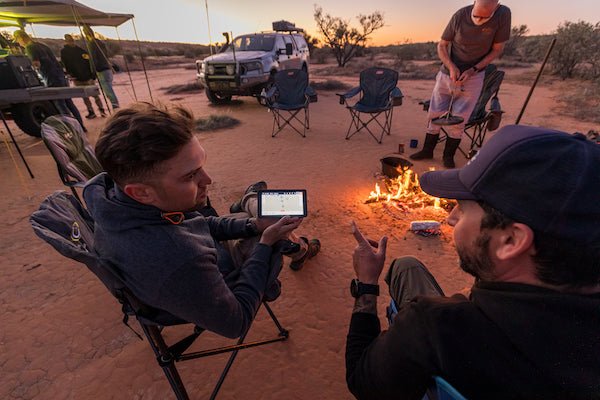
Rule number one of camping etiquette: give people space.
Some travellers are chasing quiet, stars and solitude. Others are social and catching up with mates. Neither is wrong — but if you’re there to be loud, set up well away from those clearly seeking peace.
When space is limited:
- Keep noise down after dark
- Don’t shine lights into other camps
- Avoid blocking access tracks or entrances
The bush has room for everyone. Use it.
Drive as though there are people everywhere
Campsites, beaches and bush tracks are shared spaces.
Slow down:
- Around camps
- Near people, kids and dogs
- On beaches — speed limits apply and are often lower than expected
High speeds throw dust, stones and sand, disturb the peace and put lives at risk. Lower speed means less damage, less noise and fewer problems.
Look out for each other
In remote areas, community matters.
If you see someone stopped on the roadside, slow down and check they’re okay. Offer help in camp if someone needs a hand. Often, the people you meet become the highlight of the trip.
Final advice
Four-wheel driving and bush camping offer access to some of the best places in Australia. But that access depends on behaviour.
Respect property. Protect tracks. Minimise impact. Pack out everything. Follow local rules. And, hey people, talk to people!

(Credit: Getty Images / Bundit Minramun)
Sustainable travel isn’t about big gestures. It’s about consistent, thoughtful decisions.
Travel lighter. Tread softer. Leave places better than you found them.
Because the tracks, camps and coastlines we love won’t look after themselves — and they’re counting on us to get it right.

(Credit: Getty Images / P.A. Thompson)
Do the right thing and these places stay open, healthy and welcoming — not just for you, but for everyone who follows.
That’s 4WD and camping etiquette.
Outback, bush and beach style.
Related articles
4WD, caravanning, camping and environmental etiquette: Part one
4WD, caravanning, camping and environmental etiquette: Part two
State vs national parks — untangling the rules before you roll in
Sustainable Solutions for Self-sufficient Ethical Camping